
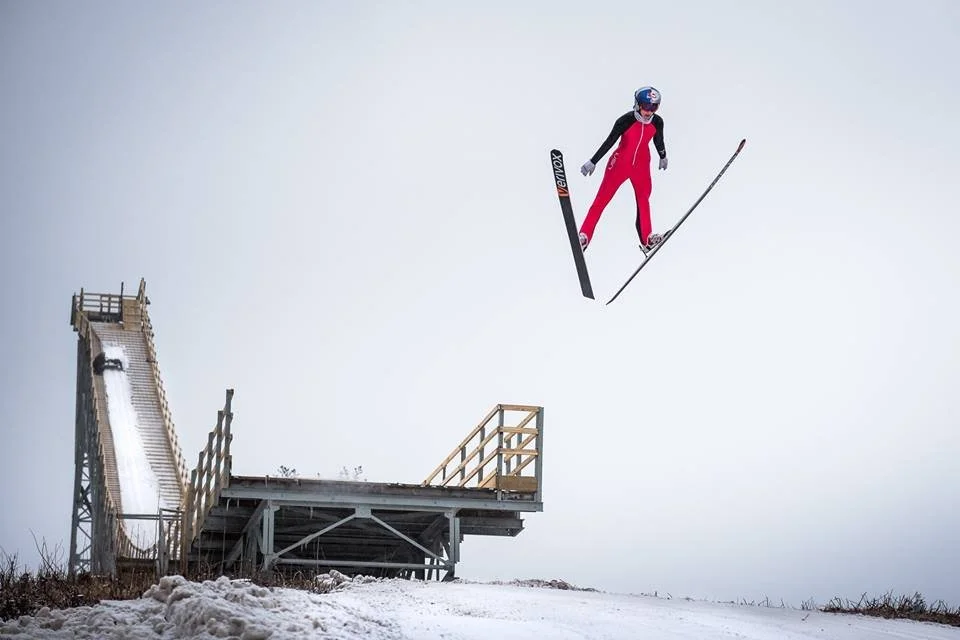
Nansen Ski Jump, 1972
02-15-18
‘Sleeping Giant’
Can the first female Olympic ski jumper help bring jumping back to N.H.?
“Being part of that historic moment with those 29 other women from across the world was kind of like breathing a sigh of relief that we finally got our foot in the door.” – Sarah Hendrickson, Olympic ski jumper
The “Sleeping Giant” awakes!
New Hampshire’s most dramatic winter Olympic icon – the Nansen Ski Jump, site of the 1938 Olympic Trials, nicknamed “The Sleeping Giant’ – is coming alive, awakened from a 40-year sleep through collaborative efforts in historic preservation, simultaneously bringing women’s ski jumping into the limelight. Timing could not better – as the 2018 Winter Games inspired the project.
Built in 1936 by the city of Berlin and the National Youth Administration, and named for a Norwegian explorer who skied across Greenland, the Nansen Ski Jump – at 171 feet high with a 312-foot outrun – was the tallest free-standing ski jump in the world. At its completion in time for the 1938 Olympic trials held in Berlin, it attracted 25,000 spectators with events announced on 87 radio stations. The Nansen Ski Jump regained its prominence by hosting four national championships before 1973. It was closed in 1988.
Four years ago, the Friends of the Nansen Ski Jump and the city of Berlin collaborated with the New Hampshire Bureau of Historic Sites – a division of the New Hampshire Division of Parks and Recreation – to begin plans to partially restore and facilitate the opening of the Nansen Ski Jump as a spectator-only State Park, with the state’s investment of $150,000.
But serendipity changed all that. When members of the Red Bull Brand Team travelling in northern New Hampshire noticed the grand dame of ski jumps as it sits on a knoll, in Milan, 16 miles north of Berlin, visible from Route 16, they thought of Sarah Hendrickson, a 22-year-old Red Bull-sponsored pioneering female ski jumper, World Cup champion and spokesperson for her sport. In speaking with Ben Wilson, head of the N.H. Bureau of Historic Sites about the ongoing Nansen Ski Jump restoration project, an idea was hatched.
“Sarah realized she could help expedite the rehabilitation and give the big Nansen a face-lift by partnering with New Hampshire Parks,” explained Jenner Richard, athlete marketing for Red Bull. Could the restoration be completed in time for Sarah to do one pre-Olympic training jump off the old Nansen prior to PyeongChang?
Sarah’s connection to New Hampshire is that her parents grew up in Plymouth. Her story is intertwined with the story of American women’s ski jumping – and its ongoing struggles to become an Olympic event despite the fact that men have competed in Olympic ski jumping since 1924 – the first Winter Games.
After decades of excuses, in 2008, American ski jumper Lindsey Van and a group of women from five countries – including Sarah Hendrickson – sued the Vancouver Olympic Organizing Committee for the right to compete in the 2010 Olympics. Though the lawsuit failed, public outcry eventually won out. In 2011, the International Olympic Committee complied and added one women’s ski jumping event – the Normal Hill – for the first time in the 2014 Sochi Winter Games.
At that moment, Hendrickson was on top of her game. At age 19, she had dominated the 2012 inaugural World Cup women’s ski jumping circuit – and had won the 2013 world championship – earning her spot to represent the United States at Sochi.
Then, in Germany, less than six months before the Olympics, Hendrickson overshot a jump and blew out her knee. She rehabbed, recovered enough to compete, but finished 21st, the lowest ranking in the field. Despair became triumph when the Olympic Committee called for the lowest-ranking skier to go first – meaning that Sarah Hendrickson became the first woman ever to jump in the Olympic Games.
Red Bull sponsorship of the Nansen Restoration Project – to the tune of $75,000 as of early 2017 – made Sarah’s jump possible. On March 7, 2017, Sarah jumped off the Nansen. The Red Bull video of that jump ignited interest in the Nansen beyond restoration. Jay Poulin, secretary for the Friends of the Nansen Ski Jump, said, “Right from the get-go, our goal was preservation of the jump – never about jumping. However, along comes Red Bull.”
The restoration of the decking alone required 22 tons of lumber. To date, present restoration efforts have included: evaluation of the steel structure; engineering surveys; a USA Nordic FIS-Compliant profile analysis; enlistment of key active jump “expert” consultants; and landscaping. The group estimates that fundraising $300,000 will complete the restoration project. Future tasks include: installing electrical power; a water pump house; piping for snowmaking; in-run track; guardrails; starting boxes; wind screens; new judges tower and new stairs.
Restoring the Nansen Ski Jump galvanized local interest. Greg Baier, owner of Knollstone Contracting, whose crew spent six weeks in Milan, in November 2017, rebuilding the decking, said of the locals, “They’re all about it. It’s like having Gillette Stadium built in their backyard.” Meanwhile U.S. Nordic Sport Development Director Ted Hinkley has been working with the Friends of the Nansen Ski Jump to designate Nansen Ski Jump as an Historic Landmark and place it on the National Register of Historic Places.
The short range dream is to get the Nansen Ski Jump “competition-ready” in time for a proposed “Eastern Four Jump Tournament” in February 2019 – include Nansen, with jumps in Salisbury, Connecticut; Brattleboro, Vermont; and Lake Placid, New York.
The long range plan is to hold yearly events to revitalize the Nordic tradition in New Hampshire, by building smaller jumps to encourage interest in the sport, including a 28-meter hill for high school jumping in Berlin. New Hampshire is the only state in the country offering high school ski jumping – with Plymouth, Proctor Academy, Merrimack Valley, Lebanon, Hanover, Sunapee and Kennett all hosting teams.
On Dec. 31, 2017, Hendrickson – after sustaining four knee surgeries – won the U.S. Olympic Trials, the first female ski jumper to make Team USA. Meanwhile, chosen by her peers worldwide to represent her sport in the International Ski Federation, Sarah continues to battle for equal inclusion. Hendrickson.
“I still have more work to do to push getting a large hill event and team events and even equal prize money.” Hendrickson also is working hard to empower young girls to consider ski jumping – and interest in the sport is growing. According to Bill Demong, executive director of USA Nordic, in last year alone, there was a 32-percent increase in youth participation with interest highest among girls in the Midwest and East.
Three days ago, at PyeongChang, two-time Olympian Sarah Hendrickson finished 19th, with a final jump of 86 meters. But her legacy is much more expansive than the seconds she spent in the air and the years she spent in her sport.
Surely her competitive mindset and generous spirit expresses a “Red Bull” challenge – risk-taking founded on belief in the face of doubt, spurring a wave of emotion that can transform an eyesore on the edge of Route 16 in the north country of New Hampshire into an icon that will bring a community – and a state – together in ways we have yet to fathom.
D. Quincy Whitney is a career journalist, author, historian and Nashua resident of more than 40 years. You can reach her through the Contact page on this site.