
04-05-18
Petals, Patters and Pathways
The teasing tessellations of nature
“Everything has beauty, but not everyone sees it.” – Confucius
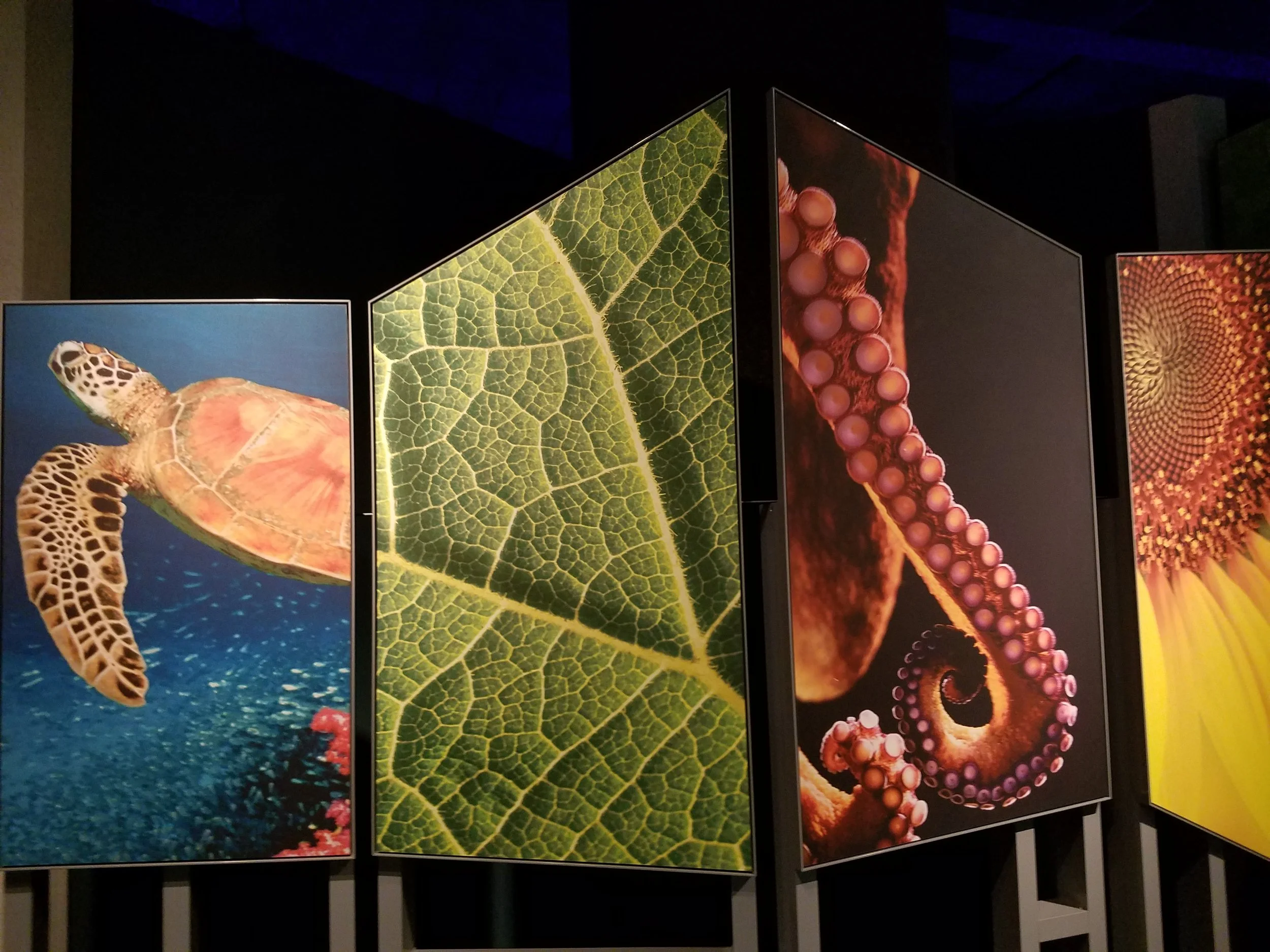
Now you see it, now you don’t – whether it is a mirror maze or the patterns and pathways of Nature hidden in plain sight. “Numbers in Nature – A Mirror Maze” is a temporary exhibition at the Boston Museum of Science that the curious should not miss.
We human beings are curiosities in the primate world because of the unique nature of human consciousness – we have the ability to tune in or tune out while still remaining in our bodies. We look but don’t see; we see but don’t notice. In a world in which technology continues to distract us further from ourselves and from our surroundings, it is helpful to see what we do with “seeing” hopefully to help us catch ourselves when we miss something.
As a wordsmith, I steered clear of higher mathematics – physics in particular, which I now love – but I always loved geometry – the mathematics of shapes. One common geometric pattern is a tessellation – a repeating pattern of similar shapes without gaps or overlapping. While you see tessellations everywhere in nature and in our own bodies, nothing quite prepares you for walking through a 3-D tessellation of mirrors. The experience causes you to rethink the idea of direction and immerses you in a repeating illusion.
As I happen to be an identical twin, walking through this hall of mirrors spooked me at first, looking from the inward world, out. I became disoriented, almost upset with the fact that I kept running into walls and images of myself. But the reverse was also enlightening. For the first time, I suddenly saw myself from the outside, looking in. I saw myself as others see me – or saw me and my sister when we were growing up. It is arresting to “see double.” The other aspect is the idea that similarities are never perfect replications – a lesson made manifest in the rest of this fascinating exhibition that deals with the Numbers of Nature.
A new revelation for me was the idea that mathematics actually “mirror” nature. Numbers both describe and explain the infinite patterns of Nature. Numbers are the language of nature; mathematics is the bridge between art and science.
Patterns often reveal the function they perform, giving us clues about how nature works in wildly different situations from swirling galaxies to the intricacy of a spider’s web. Patterns reveal that Nature is essentially non-linear, prone to curves and irregularities, spirals and tessellations where a multitude – a “community” – of simple shapes create infinite complexity.
Patterns demonstrate the beauty of proportion and balance. The Golden Ratio reveals clues about the relationships between things – the numbers of petals in a flower, the proportions of the human body, or the swirling, serpentine shape of a violin that displays a very specific mathematical ratio between length and width.
Spirals reveal how things grow, expand or respond to physical forces. Some spirals expand evenly with each turn, while others get larger as they grow, like the cochlea inside our ear, a nautilus shell, or a fiddlehead fern.
Voronoi patterns demonstrate the efficiency of Nature in packing things together. Nature will take the shortest path, create the tightest fit or go to the next neighbor. Think of an ear of corn, a honeycomb or a giraffe’s skin. The same voronoi pattern is found in the swirl in my latte as in a dragonfly’s wing.
Some patterns, at first glance, appear irregular or random but may be just the opposite – as in a fractal pattern, a pattern that emerges from repeating rules – a tree branch dividing into smaller branches, a useful pattern to fit a large surface area into small volumes. Fractal patterning of our skin gives it flexibility and allows us to stretch or allows the sea fan in a coral reef a way to capture light and food.
The bilateral symmetrical patterns of butterflies and insects suggest order and balance – but no pattern in Nature is perfect. Nature breaks her own rules. Though DaVinci’s Vitruvian Man illustrates the body’s ideal mathematical proportions, we are each evidence of thousands of variations. Sergei Rachmaninoff, born with exceptionally long, flexible fingers, hands that could reach well beyond an octave, composed pieces that no other pianist could play. With his extra-long torso and wide wingspan, Olympian Michael Phelps propelled himself through the water in ways his shorter-legged competition could only imagine.
Patterns display time, revealing Nature’s clocks. Each ridge of a ram’s horn records one year of life, but uneven growth – growing more quickly on the outside edge than on the inside – creates an uneven spiral that thrusts outward, a great defense mechanism against other rams. A tree’s concentric growth rings record an even spiral of time.
We hear patterns – in a wonderful time-space conundrum, we listen to length. That is, the octave is built on proportions of lengths – of an air column or a string. We play one string, then cut the string in half by placing a finger on it, and the tone we hear from a string half as long is exactly twice as high. But again, that system of pattern is imperfect – so we adjust our hearing to a “tempered” musical scale reflecting the imperfections of the mathematical pattern. Johann Sebastian Bach, a master of musical tessellation, created one canon in which notes are played backwards and forwards at the same time.
We are fascinated by patterns because we are patterns. Thousands of patterns allow us to think – with the fractal branching neurons in our brain – and breathe with the tree-like branches of our bronchial tubes. We hear patterns in the ocean waves and in birdsong. We think in proportion and love patterns so we copy patterns in Nature. What else explains the fact that cultures thousands of miles apart, separated by centuries, produce similar patterns in architecture – from Greek temples to Russian minarets to spiral-shaped Olympic stadiums?
What can we learn from the patterns of Nature? Nature is rarely smooth, round or square, and loves repetition. In patterns we see the very habits of nature. Patterns in ourselves are not only worthy of notice – they teach us to go beyond seeing, to notice how simplicity creates complexity; how important proportion and ratio are – they both help us see relationships – between cells and between people. In our own patterns of relationship, do we practice valuable habits of creation, or do we “see” an old pattern in ourselves that we need to move beyond?
John Lubbock, in his book The Beauties of Nature and the Wonders of the World We Live In reminds us of the dicey nature of seeing: “What we do see depends mainly on what we look for…In the same field, the farmer will notice the crop, the geologists the fossils, botanists the flowers, artists the coloring, sportsmen the cover for the game. Though we may all look at the same things, it does not follow that we should see them.”
D. Quincy Whitney is a career journalist, author, historian and Nashua resident of more than 40 years. You can reach her through the Contact page on this site.