
The Taize bell tower at the entrance to Taize, France.
05-31-18
Sound into Silence – The Democracy of Song
“Don’t let yourself forget that God’s grace rewards not only those who never slip, but also those who bend and fall. So sing! The song of rejoicing softens hard hearts….Singing summons the Holy Spirit…. Don’t stop singing.”
–Hildegard of Bingen
I do not know which came first–my love of Chaucer and the medieval point of view or my love of Gregorian Chant which must somehow be connected to my love of cathedrals. And of course, the first cathedrals–like Chartres–in the 12th century were also monasteries–filled with the sound of plainchant. In the case of the very early church, the time of Hildegard de Bingen, visionary mystic and composer, the songs lifted to the rafters were sung by both men and women. So there was an ancient premise for communal song.
I am drawn not only to simple melodies and the harmony of unaccompanied voices, but also the idea of plainchant being sung as prayer. There were no auditions among the monks. There was no choir director deciphering which voices did not “belong.” I discovered proof of this fact in my research for American Luthier. The organistrum or symphonia, later referred to as a hurdy-gurdy, was a monochord played with a “continuous bow” wheel that enabled a cantor or monk to teach himself to sing the liturgy sine magistro–without the help of a teacher.
Some years ago, my sister, a seminarian and former hospital chaplain, first told me about Taize, a little town in east-central France, home to about 100 people. It is not especially remarkable except in its legacy as a holy place because of one monk in World War II–Brother Roger. A native of Switzerland, Brother Roger came to France–his mother’s birthplace–to escape the Nazis and settled in Taize where he began sheltering Jews. Though he had to flee when his activities were discovered in 1942, he returned to Taize in 1944 to minster to those in need.
In the 1960s, the Taize Community began to change as young people, seeking to satisfy their spiritual hunger, began to come in droves, touched by the spirit of the community. Brother Roger developed a style of worship and singing more suitable to pilgrims hailing from different countries. He surpassed the language barrier by using Taize songs of very few words–often from the psalms–making it easy to sing them without knowing any particular language or needing musical training. Over the years, the Taize liturgy became rooted in monastic traditions of chant and contemplation, sung three times a day, a practice that now draws 6,000 people to visit Taize each summer. Brother Roger’s community has since grown to include more than 100 brothers from 30 countries, none of whom have to denounce their denomination affiliations.
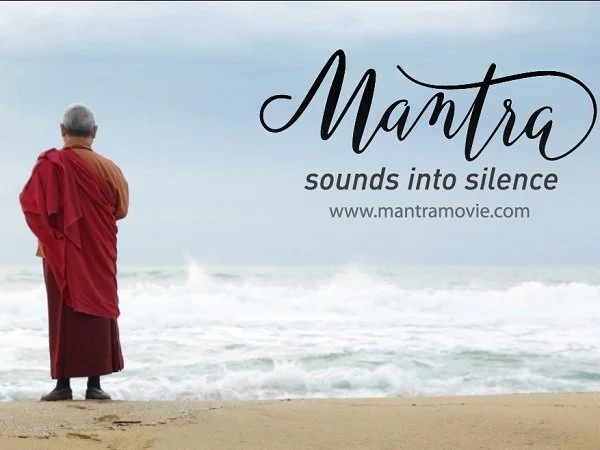
A new documentary film Mantra–Sound Into Silence, a documentary about music, meditation and chanting, directed and edited by originator Georgia Wyss, produced by Tengotwo, Films, Sri Lanka, is being released in hosted screenings around the world.
Mantra, the word, says it all. Man means mind; tra means transcend. Mantra is a simple way to transcend the chattering of the mind. As one person described it, “A way to sing back against the things of attachment–self-hatred, anger, neediness. Addicted to cocaine, I sang to get rid of dark shadows in my heart.”
Wyss explained the premise for her film: “In our always-on, supposedly connected world, people are increasingly losing the most important connection of all: the one to themselves. I have also experienced this disconnection and chanting, also known as Bhakti Yoga or Kirtan, allowed me to not only connect on a deeper level with myself, but also recently helped me through a difficult event in my life, letting go of someone very close to me….Kirtan is for anyone and everyone regardless of background, it is the universal language of heart.”
In her film, Wyss interviews renowned chanters in Barcelona and then, thanks to generous crowd funding support, tours important kirtan gatherings around the world in the U.S., Greece and Russia and to India–Vrindavan, Rishikesh, and Kathmandu–the birthplaces of kirtan.
Mantra is repetition and a slowing down to the rhythm of Nature, a moment to re-experience time. No background is needed. The point is to consciously leave worries, judgments, thoughts and expectations behind to surrender to the simplicity of “boulders of energetic sound”–the energetic high of community song. One person observed: “Even if you don’t understand the sounds, it increases the vibrational level of the heart.”
The film aptly brings to life all the avenues of life in which song is sorely needed. Bringing kirtan into San Quentin proved transformative. One prisoner said: “Mantra allowed me to go into myself, to feel bliss, to feel completely free–even in my cell.” A therapist observed that the communal vibrations of group song worked with the spiritual issues that make up the “soul work” necessary for prisoners to get in touch with themselves.
Research shows that saying a simple “SA-TA-NA-MA” chant 12 minutes a day actually drives the autonomic nervous system and changes the brain over a period of months, increasing brain activity as evidenced by the fact that the frontal lobes of the brain thicken. In my own practice, I have found that this simple chant rests the brain–it gives it a breath of fresh air.
One person noted: “You are not losing yourself–but becoming yourself. You burn away unnecessary things and let go. Mantra purifies negative states of mind.” Mantra is the democracy of sound; the inclusive community vibration that an assuage a “fearful mind” or a “hard heart,” according to those interviewed in the film. Culturally speaking, singing and dancing together is an ancient practice that for Americans, for the most part, has become almost extinct in our daily lives. Sound–chanting syllables or phrases–goes beyond language in a visceral way. There is no need for translation. Sound itself dissolves boundaries between people.
In India, the river Ganges is considered a holy river, and so a common practice is to place lit candles on the water as offerings. One of the most memorable moments in the film is when a Tibetan monk is standing on the beach chanting. Wyss explained: “We filmed him chanting on the beach because when he chants, he does not only do it for himself, he does it for all beings on the planet. So by standing on the beach, it symbolizes reaching out to other places in the world”–with the universal, non-translatable sound of community song. “Lama Gyurme believes that by chanting, he can also uplift his surroundings.”
Tengotwo Films is marketing their film “Mantra–Sound Into Silence” through host screenings in an effort to not only reach more communities, but to hopefully catalyze interest in creating mantra singing community experiences–locally. This film was recently shown in Burlington, Vermont, and Portland, Maine. Could Nashua bring it to New Hampshire? For more information, see www.mantramovie.com.
Quincy Whitney is a career journalist, author, historian and lifelong New Hampshire resident. You can reach her through the Contact page on this site.