
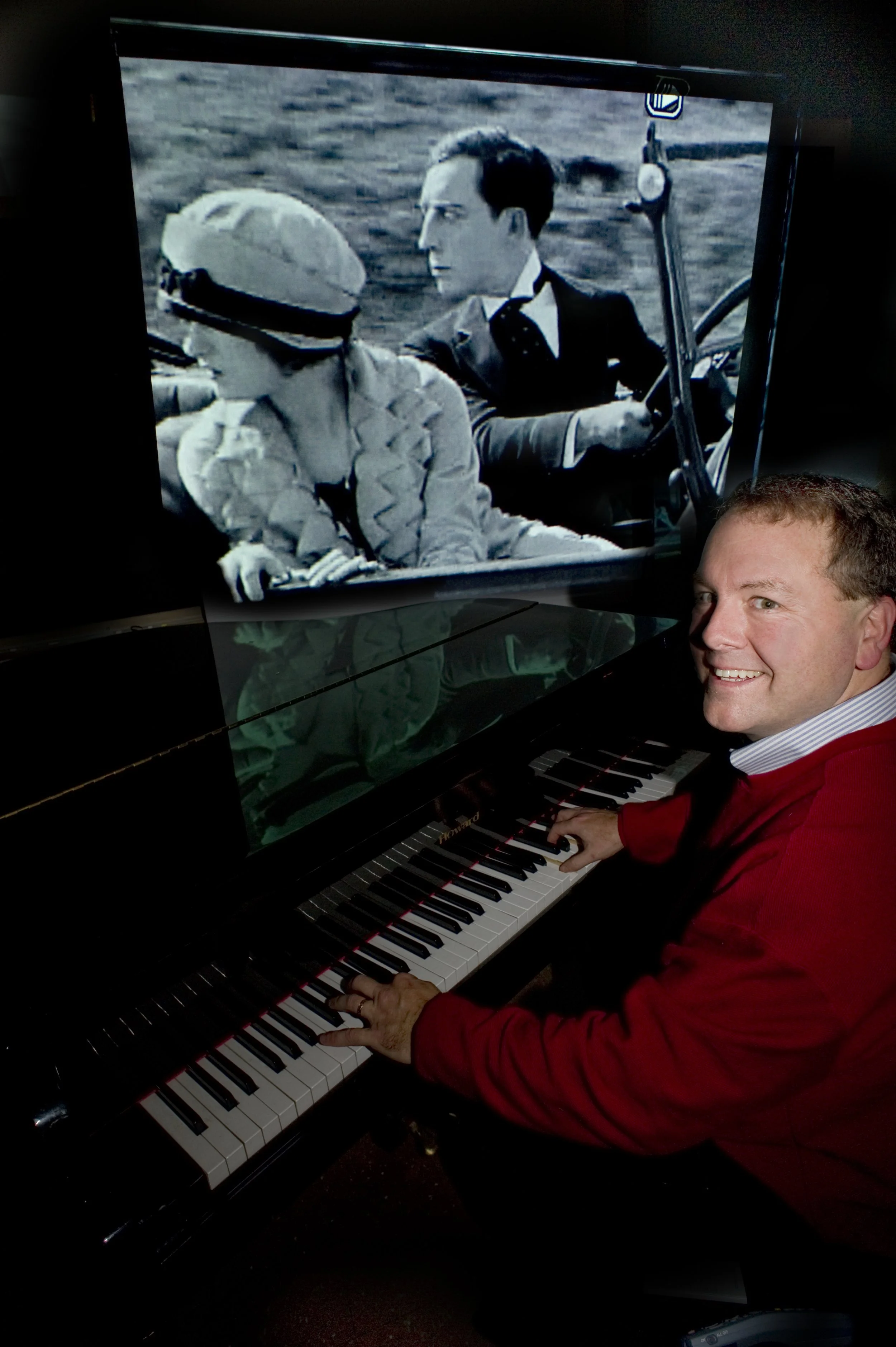
Nashua native Jeff Rapsis has been bringing silent movies ‘back’ into our lives by performing live musical accompaniment for these classic pioneering films.
07-12-18
Silent films take us on a different journey
“It is in vain that we say what we see; what we see never resides in what we say.”
–Michel Foucault
Language often misfires–it requires translation across cultures and across the breakfast table. One sentence can be said in 10 different ways and mean 10 different things. There is a reason that humor–with its complex matrix of metaphor, subtlety and sophisticated references–is the most difficult thing to translate into words across the international cultural divide.
Conversely, there is an immediate, universal honesty and intimacy in non-verbal communication. Like a fine melody, an image, a gesture, a look, a movement can give a world of meaning. There are few art forms that demonstrate the power of imagery better than silent film.
While some may dismiss silent movies as irrelevant relics of the past, they are surprisingly relevant–perhaps especially today in these times of constant distraction and way too much information coming at lightning speed. True, silent movies represent a frozen time–captured in the foreign-looking costumes, settings and props of the 1920s, the heydays of silent film. But there is also a surprisingly real timelessness about the distilled abstraction of imagery without words. And nobody did it better than Charlie Chaplin.
In The Alphabet Versus the Goddess: The Conflict Between Word and Image, brain surgeon Leonard Shlain gives a brilliant explanation for the century-old iconic power of Chaplin. Shlain argues that for centuries, western culture literally worshipped words–was, in fact, held hostage by the left hemisphere of the brain. Left-brain dominance began with the monks copying medieval manuscripts–the single cultural act that spawned a culture ruled by a literal, linear, “either/or,” warlike cultural mentality.
According to Shlain, Chaplin was nothing less than the linchpin for a massive cultural shift in western culture–away from the literal translation of words to the liberating power of image. In 1900, just as the “electric motion picture projector” began unfurling a stream of negatives past an intense light, physicist Max Planck discovered “ragged discontinuity” in the atomic world, a “minute jerkiness” that began to unravel linear ideas about cause and effect, making room for the non-linear, the illogical, the spontaneous, the random–proof of the unexpected.
Shlain: “Chaplin was the showman of the incongruous, genius of the jerky gesture…master of the bellylaugh. A clown who poked fun at the serious endeavors of the left brain, he did so without using a single word. With pantomime, facial expressions, and a signature waddle, Chaplin showcased the communicative power of the right hemisphere.”
For the past 11 years, Nashua native Jeff Rapsis has been bringing silent movies “back” into our lives by performing live musical accompaniment for these classic pioneering films. When he is not at his day job as a founding partner of an entertainment publication, Rapsis travels New England and throughout the country, improvising his musical scores to silent films. “No performance is the same,” said Rapsis as we sat last week in the Nashua Barnes and Noble. Two weeks ago, he gave his first performance in Nashua at the First Church.
A young film buff from an early age enamored of the Marx Brothers, particularly the way Chico Marx played piano, Rapsis began taking piano lessons in junior high school. His two loves merged in an epiphany on the first day of seventh grade at Spring Street Junior High School where Sebastian Salvo, celebrated Nashua public school music teacher and film collector, began showing silent movies during study hall.
“The first film we saw was Charlie Chaplin I Am. I will never forget it–Mr. Salvo said only one thing about the film–‘Charlie Chaplin is the only character in the film.’” In this 20-minute film, Chaplin, getting ready for bed, finds a thousand different ways to foil himself in the effort.
As Stephen Weissman points out in In Chaplin, A Life, the elements of early comedy–before stuntmen–are staggering. A first-rate comedian had to “execute back slides, nosedives, fanny flops, and alley oops on cue–in deadpan or in double take–deploying his body in space with the soaring ease and apparent weightlessness of a prima ballerina.” Add to that the precise science of humor–the specific rhythm needed to release two incongruous images colliding at just the right moment to catch the audience off-guard.
While attending Fordham University, Rapsis took a sabbatical from his love affair with silent film and kept his distance from music–he loved it too much. Then in 2000 when he and his partners founded the entertainment publication, Rapsis began writing about classical music for it. In 2004 Ken Keisler, Symphony NH director, asked Rapsis to do a film score for “Dangerous Crosswinds,” a serious crime drama. With the release of the film, Rapsis sought out ways to get back in to film.
In 2007, he pitched the Palace Theater to run the silent film Phantom of the Opera on Halloween night. Despite plans to write a complete score, time got away from him, and Rapsis had to improvise. “I discovered it was so much better to be playing freely with the film in real time. As the musical line follows the emotional arc of the film, you become one with arc of the story.”
Rapsis soon discovered that the way a musician performed live music could make or break the experience for an audience. While attending a silent film festival, he noticed the accompanist played loud circus music throughout the film, drowning out the audience and the film.
Rapsis discovered the very same thing that Chaplin discovered–you needed to provide the space of a pause to allow the audience to share the laughter. Rapsis likens performing music to a silent film to that of a fly fisherman–“you have to cast the melody out, then reel it in slowly, and know where to go with the next tune.” Rapsis also feels the need to “curate” silent film, that is, to foster it in live theater settings, where it began because television–or even worse, phone technology–does not do it justice.
According to Rapsis, there were about 11,000 silent films made, with 80 percent of them irrevocably lost, leaving approximately 1,000 in existence. Rapsis has accompanied 304 different silent films–and is always looking to discover a new one he has not seen. “I collaborate with dead people,” said Rapsis. “When you make music all the time, you develop your own style. You store up your own bank account of musical gestures.” Not unlike the bankroll of gestures that became stock and trade for Chaplin.
Chaplin said: “Life is a tragedy when seen close-up but a comedy in long-shot.” In silent film, humor and pathos intertwine in an image, a movement, a gesture, a look–those intangible things beyond words. For Rapsis, silent films distill everything down to what is important–“the big emotions, the big moments that remind us what matters in this world of distraction–those moments when we fall in love, family, friendship, loyalty, being alive.”
Quincy Whitney is a career journalist, author, historian, biographer and poet and a lifelong New Hampshire resident. You can reach her through the Contact page on this site.