
11-16-17
Granite Reflections
“We do not know what things look like, as you say, we know what things are like. It must be a very limited thing, this seeing.”
– Aunt Beast, Wrinkle in Time, Madeleine L’Engle
Seeing is believing – or not! How did the “White” Mountains get named?
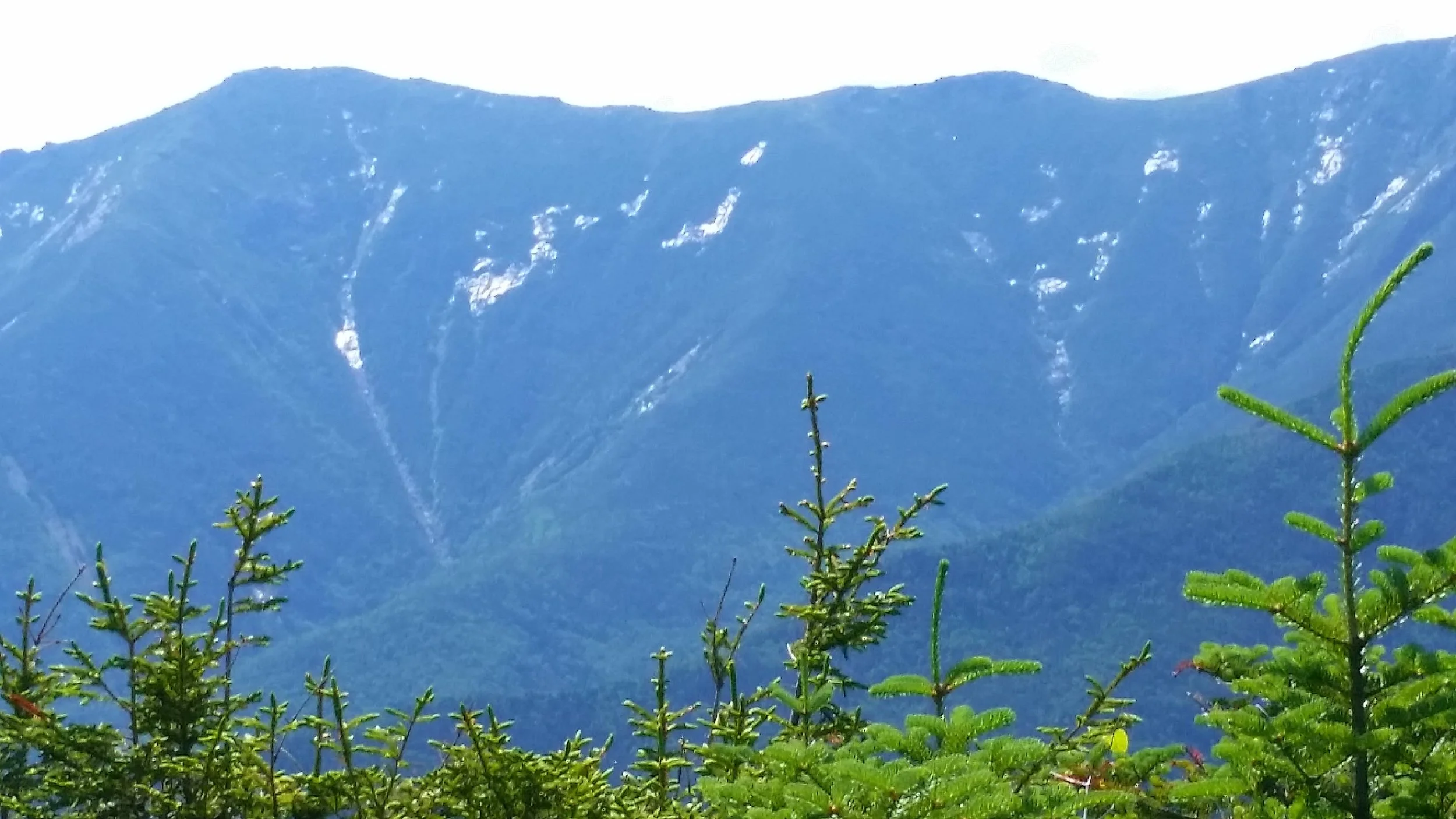
“Common” knowledge suggests the name refers to snowcapped mountains. The reality is different and deeper than snow. “White” refers to the sunlight reflecting off the exposed faces on the mountains. Naysayers claim this idea is a myth. But last June, I took the Canon Mountain tramway on a glorious sunny day. As I walked the rim trail and looked out over the Franconia range – Mounts Lafayette, Lincoln, Little Haystack, and Mount Liberty – sure enough, the faces and cliffs shown shiny and bright – white! – from the mica imbedded in the granite.
This idea seems an apt way to begin a column that will traverse a lot of different trails; explore and explode some myths about what we think we know; and celebrate the ways in which we often hold on to “truths” that are not that at all. My journey as a Boston Globe cultural news reporter took me on variegated paths while chasing the trail of creativity, a path that knows no boundaries. Artists explode pre-conceived ideas with new perspectives – just like the fact that while walking the rim trail, one sees a whole range of “surprise” mountains that cannot be seen down below. Things are not always as they seem.
My fascination with this concept began, literally, at birth. As I am an identical twin, appearances have always been both real and surreal to me simultaneously. The “white” appearance of the mountains is, itself, an illusion – reflections are surely the ultimate deceptions. But then, so are the fall colors we chase every autumn. The human brain and the eye collude to create the concept of color, a concept peculiar to the human experience.
We think that falling leaves represent death when it is, in fact, a vital sign of the life of the tree, as only living trees can reveal these colors. Another curiosity is that as the Mount Washington Auto Road takes you up, you are actually going north and back in time as every foot of elevation parallels hundreds of miles in latitude so that the summit trees resemble those of the arctic tundra and are hundreds of years old.
What’s more, reflections are, by nature, reversed – but why and what difference does that make? Evidently, Nature is full of mirror asymmetry and reversals. For example, the limonene molecules that give taste to oranges and lemons are actually exactly the same – except that one is right-handed and the other left-handed.
Such mysteries are everywhere – in the physical world, as well as in the invisible molecular worlds that make up the physical. When I began writing for the League of New Hampshire Craftsmen, blacksmiths and weavers, glassblowers and woodcarvers taught me great respect for those who make objects with their hands, as they must master the art of design and the science of materials. My first artist profile for the Boston Globe New Hampshire Weekly in the spring of 1987 was about a Nashua artist – internationally renowned still life / portrait painter James Aponovich. My second Globe story profiled three craftsmen – woodworker, metalsmith and stained glass artist – whose work adorned the rebuilt St. Paul’s Church in Concord, previously destroyed by fire.
Boston Globe Pulitzer-Prize-winning columnist Don Murray who was a cherished mentor to me and so many New Hampshire writers, invited us all into the democracy of the creative process, claiming that “we all begin with the blank page.”
During the summer of 1988 at the National Playwrights Conference at the Eugene O’Neill Theatre Center, I learned I was a misfit theater critic because I identified more with the playwright than the critic. I also earned about the serendipitous and indirect nature of the creative process. Pivotal moments often happen tangentially. While failing as a critic, I uncovered a more urgent writing project that has consumed me for decades. After what seems like a lifetime of discarding unsuccessful drafts, I am still exploring the best way to write about my life as a mirror twin.
Somewhere along the way, I became enamored of a book that changed my life – Walking on Water: Reflections on Faith and Art by Madeleine L’Engle. With each artist I interviewed, I envisioned giving this book away. L’Engle still unfolds many layers of truth for me – ideas about the space between things; creativity and faith; doubt and certainty; physics and metaphysics. I studied with L’Engle and helped her with a play about her book The Glorious Impossible. Though the project never materialized, L’Engle continues to inspire me daily.
In 1998, the cultural organizations in the state promoted New Hampshire as the featured state at the 1999 American Folk Life Festival. For three weeks, New Hampshire was featured on the National Mall, with a real-life covered bridge and a maple sugar shack built expressly for this outdoor exhibit. At the request of the New Hampshire State Council on the Arts, I researched our state’s most important legacies, resulting in my first book Hidden History of New Hampshire (Acadia, 2008).
Meanwhile, L’Engle led me to read quantum physics. A series of Boston Globe articles that I wrote on the “Scientist As Humanist” project inspired me to pursue stories where science and art overlapped. In August, 1997, I attended a New Hampshire Humanities Council lecture by Doris Kearns Goodwin – never imagining I was about to become a biographer! The person next to me suggested I meet violinmaker Carleen Hutchins who lived in a cabin on Lake Winnipesaukee. After my article ran, Hutchins asked me to write her biography. I was hooked by this art-science-music tale of a most unlikely pioneer.
Carleen took me on a circuitous journey. Two Research Fellowships at the Metropolitan Museum of Art allowed me to finish my research. In August, 2004, I interviewed 25 people in 30 days in nine countries – luthiers, physicists, musicians, composers and curators. In 2013, two events in Oxford involving Stradivari violins led to a writing residency in an English cottage near Stratford-upon-Avon, courtesy of Hosking Houses Trust, where I finished American Luthier (ForeEdge, 2016).
If, as Don Murray observed, most writers keep returning to a few resonant topics, my fascination centers on the art and science of creativity and the lure and lore of the art object.
Every day we move between inner and outer worlds, between visible and invisible worlds – all in a day’s time, working in the garden, reading a book, observing the wind. In Wrinkle in Time, L’Engle expresses a sense of wonder, when Meg’s father says: “It’s a frightening as well as exciting thing to discover that matter and energy are the same thing, that size is an illusion and that time is a material substance. We can know this, but it’s far more than we can understand with our puny brains.”
All year long, the granite of the “White” Mountains sparkles! So much so that early settlers first called these majestic mountains the “Crystal Hills.”
So much for what we think we know – there is more than meets the eye.
D. Quincy Whitney is a career journalist, author and historian and Nashua resident of more than 40 years. You can reach her through the Contact page on this site.