
11-23-17
Tower of Gratitude – for the women!
“Gratitude is when memory is stored in the heart and not in the mind.” – Lionel Hampton
All Americans owe their freedom, their lives and this Thanksgiving Day to the few – the very few. Through the centuries, the few have carried the safety, livelihood and the American way of life on their backs – literally – as servants in the military.
The ultimate sacrifice is all about the power of the individual to make a difference, one step at a time, one encounter at a time, not only for the soldier but for the “Gold Star” family left behind. Some family members never escape the horror, loss and grief while others find a way to transform it, to move beyond it, to make a legacy out of loss.
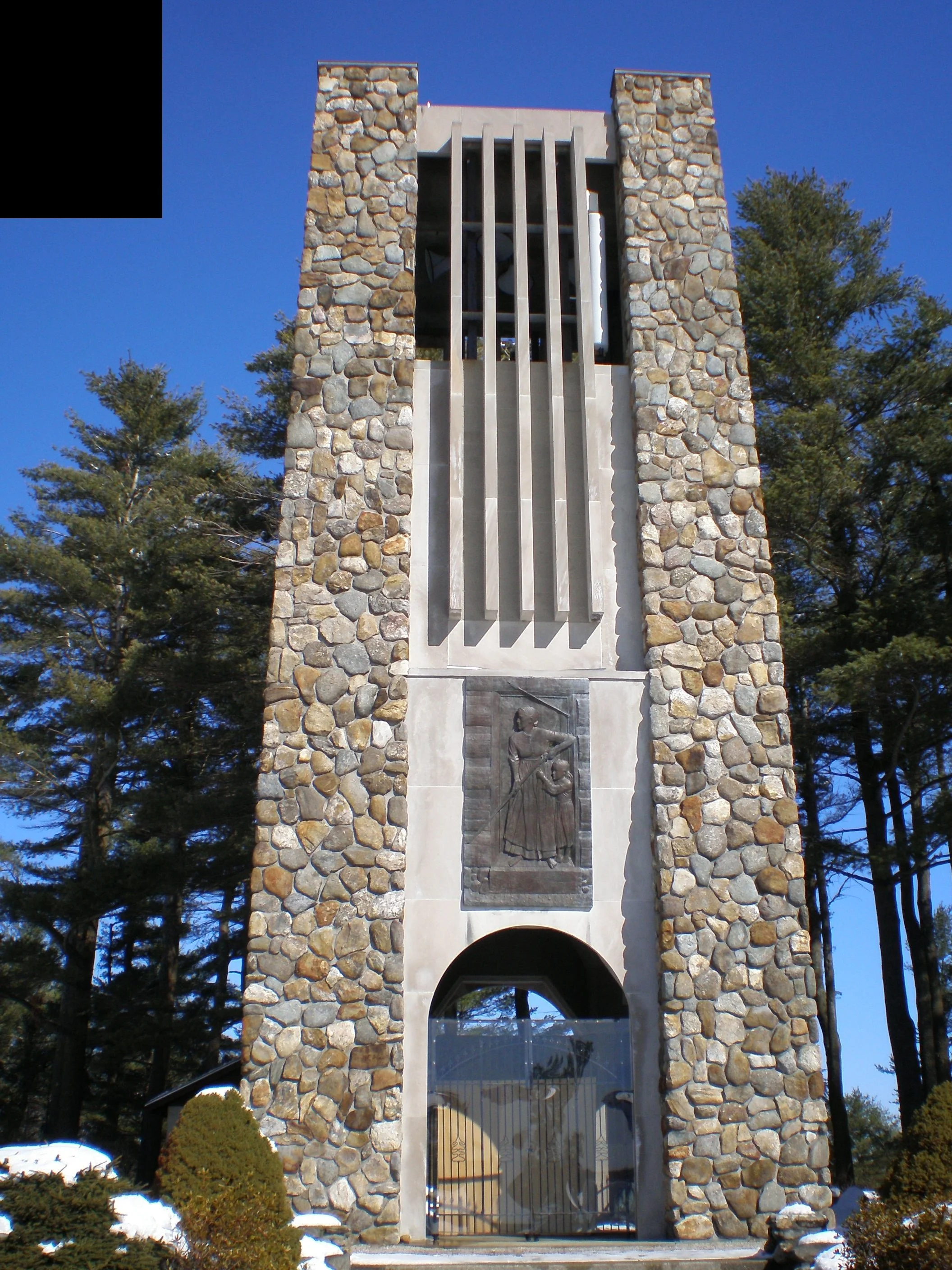
Such was the case in Rindge, New Hampshire, on the spot we now know at the Cathedral of the Pines, an outdoor chapel that overlooks Mount Monadnock – where two monuments pay tribute to American war dead, but one is much better known than the other.
On Feb. 22, 1944, when Douglas and Sybil Sloane learned that their son Sanderson, a B-17 bomber pilot, had been shot down over Germany and was missing in action, they found a way to transform their grief. In August of that year, the Sloanes conducted an outdoor service on the knoll under the pines at the family farm in rural Rindge, New Hampshire, on the spot where Sanderson had chosen to build a home. To their surprise, a cavalcade of cars came from all around to pay tribute. The kindness of friends, family and the community inspired the Sloanes to build an outdoor chapel on the grounds – a fieldstone altar looking out over Mount Monadnock which became known as the Altar of the Nation.
Sloane, a member of the Sons of the American Revolution, put the word out to other SAR societies across the country to send rocks and medals to be imbedded in the Altar. The fieldstones represented the stockpiles of rocks farmers gathered to clear the land for farming. Sloane explained: “These rocks ... symbolize a determination for better living, for freedom and for independence. ... It seems fitting and proper to ask descendents of those Pioneers to send back tokens, to bed in with those (fieldstones) dug from this land, to express the unity and strength of a grateful nation honoring all her war dead.”
In fact, in 1950, the Altar of the Nation was dedicated as a memorial to all American war dead.
But that is not the rest of the story.
A decade or so later, an anonymous woman visited the Altar of the Nation, and was so moved by it, she returned the following day to present the Sloanes with a check for $460,000. In 1953, in response to this spontaneous generosity, Sloane built the first and only national monument dedicated to women who gave their lives for their country.
The Sloanes built a 55-foot bell tower. Each face of the tower displays a nine-foot-high bronze bas relief of that depicts a different population of women. The reliefs were designed and drawn by Norman Rockwell, and executed by his son, sculptor Peter Rockwell.
Tablet No. 1, facing west, depicts the “Girls of the Combat Forces” – army, navy, marine corps, air corps, and coast guard women in uniform.
Tablet No. 2, facing east, depicts other roles in which women served their country. This relief features a Sister of Charity Nun, who tended troops in the War 1812 and the War Between the States; a Salvation Army “lassie;” a USO entertainer; a war correspondent; and a “Rosie, the Riveter,” representing the women who began working in shipyards, munitions and aviation plants, shops and factories to fill the work force during wartime.
Tablet No. 3, facing north, depicts Clara Barton, founder of the Red Cross, representing all the women nurses who served the troops.
Tablet No. 4, facing south, features the pioneer woman, holding a rifle with a child at her knee, defending her home turf in the face of war.
The Women’s Memorial Bell Tower was dedicated on May 28, 1967.
In honor of that dedication, an anonymous writer, wrote the following in a brochure entitled The Memorial Bell Tower: A National Tribute to All American Women Who Sacrificed Their Lives in the Wars of Our Country:
“Henry Ward Beecher said that if he were invited to give an oration on July 4th he would celebrate the virtues of the fore-mothers instead of the fore-fathers. The latter, he said, had monopolized all the glory although their mothers, wives, and daughters had induced quite as much and had evinced at least equal piety and heroism in subduing the wilderness and securing our national independence.”
I have visited the Bell Tower at least six or seven times. What disturbs me about this unique tribute to women – the only one of its kind in the nation – is that it still remains so unsung. I have met at least fifteen women in my travels who were married at the Cathedral of the Pines, yet not one could recall what she was walking by – a 55-foot Bell Tower that is ten times bigger than the Altar of the Nation. Despite the fact that the Bell Tower stands in the way of anyone walking to view the Altar of the Nation, most people do not see it. It is invisible in plain sight – and I ask myself why.
Is it a metaphor for the essential yet unsung nature of women’s work across millennia – the far less dramatic and often tediously repetitive work of keeping a household and family together? Like the tasks and lives of women over the centuries, history is also often invisible in plain sight – silent until it is expressed in the stories of those who came before us, those like the Sloanes who created a lasting legacy to transform their grief. The same can be said of women’s lives across the annals of history. Unless we tell their stories, they remain invisible in plain sight.
Ponder the fact that just 7.4 percent of all Americans serve in the military. And only 10 percent of that number – just 1.4 percent of all Americans – are women. How often do we think of that? How do we honor that sacrifice and service?
Taking nothing away from the men who made the ultimate sacrifice, today, I would like to put the mothers, wives and daughters – the 1 percent – in the spotlight.
D. Quincy Whitney is a career journalist, author and historian and Nashua resident of more than 40 years. You can reach her through the Contact page on this site.