
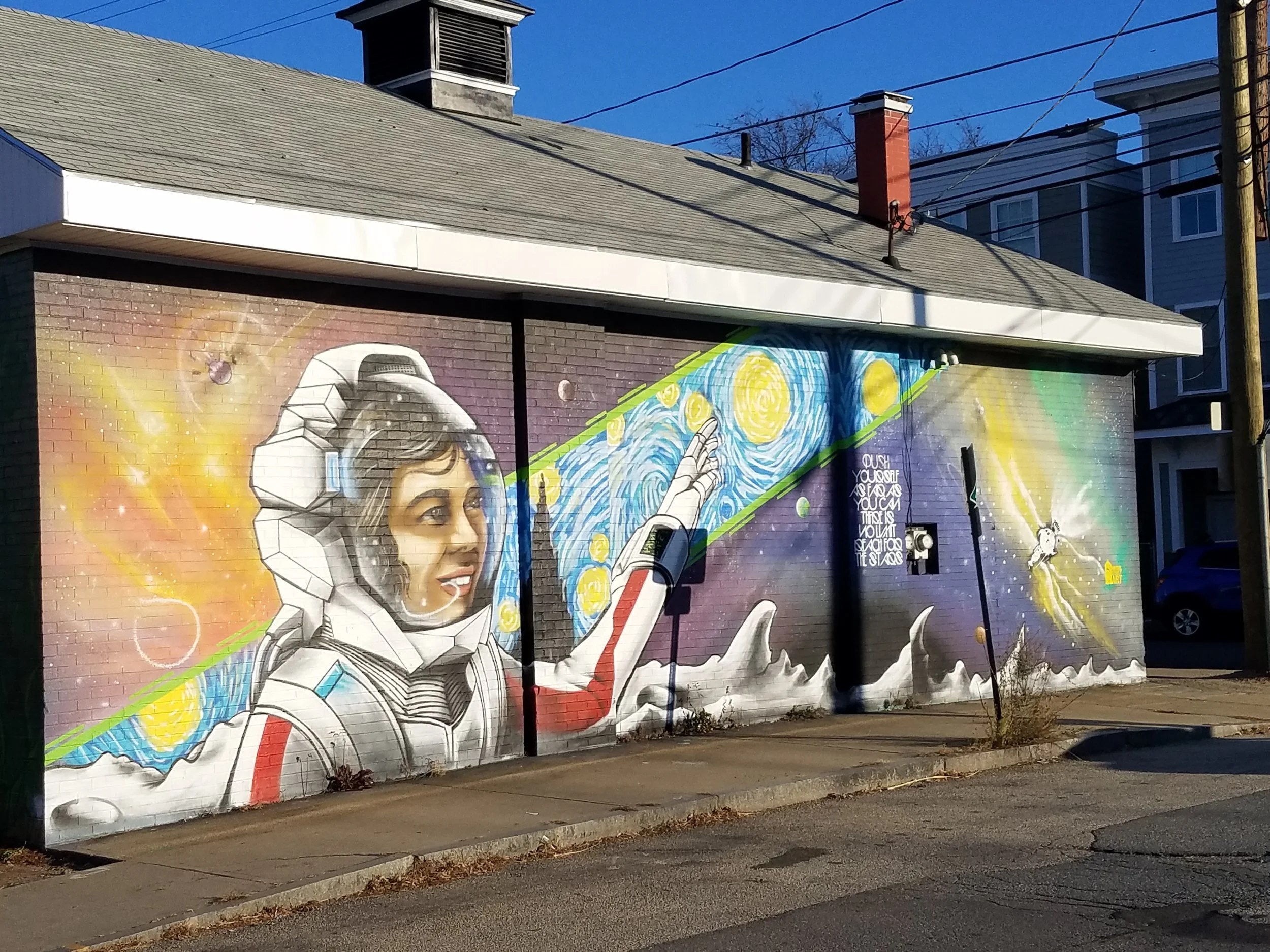
A mural titled “No Limit,” done by Nashua-based group Positive Street Art, depicts New Hampshire’s Christa McAuliffe pointing to words of inspiration that read: “Push yourself as far as you can. There is no limit. Reach for the stars.” McAuliffe was one of seven crew members aboard the space shuttle Challenger when it exploded in 1986, seconds into its lift-off from Cape Canaveral, Fla. She is considered to be the first teacher in space. The mural is located on the corner of Ash and West Hollis streets in downtown Nashua.
12-03-17
More Than Murals
Public art in Nashua leaves positive mark on city
“Art washes from the soul the dust of everyday life.”
– Pablo Picasso
Nothing transforms a place quite like public art. Sun and wind come and go; weather is transitory, but art, strategically placed, not only transforms a place, it actually creates new space. A psychic space, emotional space, contemplative space where there had been none before. There is a universal quality to public art-it can engage memory; stir the imagination; give a message; pay tribute to the past; celebrate an anniversary; listen to and embody the ideals of a community.
When I had lunch with former New Hampshire State Poet Laureate Marie Harris recently, we reminisced about one of her first pieces of public art that I wrote about in 1986. “Sunapee Mandala” was a collaboration between sculptor Emil Birch and Harris-a merger between granite and ceramic sculptural relief and 14 lines of poetry. Visited by this granite “presence,” the Sunapee hillside remains forever transformed, irrevocably touched by something beyond grass and dirt-celebrating the earth, wind and fire of seasonal New Hampshire.
Street art of a different kind, urban art can be equally as powerful but in a different way. Nothing expresses restraint and establishes its borders better than a wall – the space between – and yet nothing transforms a wall like art. Man’s desire to paint on a wall, to paint murals, is as old as humankind. Cave paintings in southern France – the Lascaux Grottoes – date back at least 20,000 years.
The word mural has its origins in the Latin word “murus” which means “wall.” Art walls not only beautify cityscapes, they also build bridges in the community.
The “Yankee Flyer Diner” mural was such a piece, painted in 1997, by Nashua artist James Aponovich, located on the Mimosa Nails wall on Main Street, opposite Citizens Bank. It marks the exact location of the iconic 1940s diner that Aponovich remembered while growing up in Nashua. In 2015, City Arts of Nashua sponsored its restoration by the artist, assisted by Elizabeth Johansson Aponovich, in their Peterborough studio.
In the last few years, there has been a surge in public street art in Nashua, due to Positive Street Art, founded in 2012, by artists Manuel Ramirez and Cecilia Ulibarri, aimed at transforming the public’s perception of and experience with graffiti. When the proprietor of the downtown Nashua Dunkin’ Donuts offered the artists their riverside wall and a thousand dollars to paint a mural, Public Street Art was born.
Murals can educate and embody positive messages as reminders to a neighborhood and the community at large. The “Garden Giant,” painted on the wall facing the Rail Trail at the corner of Ash and West Hollis streets, faces the community garden that Nashua PAL and the Nashua Health Department built to teach youth about gardening, agriculture and how to grow your own food. On the adjacent corner the “No Limit” mural, a tribute to astronaut Christa McAuliffe, the first teacher in space, encourages youth to stay active, educated and healthy, embodied in the quote that appears on the mural: “Push yourself as far as you can. There is no limit. Reach for the stars.”
When Main Street United Methodist Church demolished storefronts that had hidden its historic auxiliary building, it also revealed a long, open “free” wall facing the church grounds. Richard Lannon, owner of the Lannon Company and the Chase building in which Positive Street Art has its office, asked Ramirez to paint a mural to celebrate the 100th anniversary of the Chase Building, which had housed three theaters – the Tremont, State and Star Theaters. In the “Nostalgia” Mural, Ramirez depicted scenes from classic movies, including “The Blob,” “The Three Stooges,” “Gone with the Wind” and “It’s A Wonderful Life.”
The “Gratitude Wall,” painted by Ulibarri, located on the Santander Bank parking lot, adjacent to a PRG Rugs, emerged from a collaborative Gratitude Project that reached out to schools and asked students to submit words that expressed their gratitude. The words that form the rays of sunshine were culled from a field of over 1,200, summarizing the collective gratitude of Nashua community children and teachers.
The most recent Positive Street Art mural, “The Promise,” dedicated on Veterans Day 2017, is located on the Quincy Street wall of the Nashua Foundry. This mural is the third in the group’s “Hearts and Minds” series, dedicated to veterans, inspired by graffiti messages found on walls near vets’ gathering places that communicated their sense of isolation. The idea for the mural occurred to Ramirez after participating in a yearlong community effort to listen to vets about their experiences through informal coffee and donut gatherings and other activities.
In “The Promise,” the largest mural in size and scope, Ramirez depicted all five branches of the military – through giant profiles of soldiers in uniform. Super-imposed on each profile is an iconic experience common to military personnel and their families: a child standing in a military cemetery strewn with flags; a family reunion; a young girl saluting a Marine; a purple heart recipient saluting and soldiers in the field, stopping to help children in need.
Public murals improve what are otherwise neutral, often overlooked spaces in the city. They make walkable places welcoming and invite pedestrians and drivers to rethink their assumptions about a place. Street murals and positive urban art make us accidental tourists, in an accidental gallery that is the cityscape, encouraging us to see familiar surroundings in a new light, awakening the mind’s eye to consider new possibilities.
Someone getting off the bus and heading home in Depot Square now sees a “Gratitude” mural where there was once a drab wall. Pedestrians are drawn into Nashua history every time they pass by the “Nostalgia” mural. “The Promise” mural backs up to the rear end of the Post Office, so Postal workers see it each morning as the trucks pull out – communicating validity and support to veterans, many of whom happen to be Nashua postal workers.
One of the greatest legacies of public art is that it reaches those who might otherwise never open a book or enter an art gallery. In the case of Positive Street Art, murals have been catalysts for and emerged directly from community activities aimed at increasing connection and understanding between groups that might otherwise never meet – fostering conversations, and building relationships and community while beautifying the city.
Ultimately, public art is about leaving a mark. Particularly for the artist and an observer who takes time to notice and celebrate the present, an idea suggested by Harris, writing to the very specific dimensions required to fit carved words on stone. Her poem, carved with capital letters into the granite of the “Sunapee Mandala” reads:
“Leave your shadow here
on the long memory of rock
that you may number among
the friends of this planet.
We are one
in summer woods
overflowing with wings
in fires kindled
by orange lily struck
against fern flint,
one with the music of the wind
played on icy birch bones,
and the promise pollen spells
across the watery mirrors of our future.”
D. Quincy Whitney is a career journalist, author and historian and Nashua resident of more than 40 years. You can reach her through the Contact page on this site.