
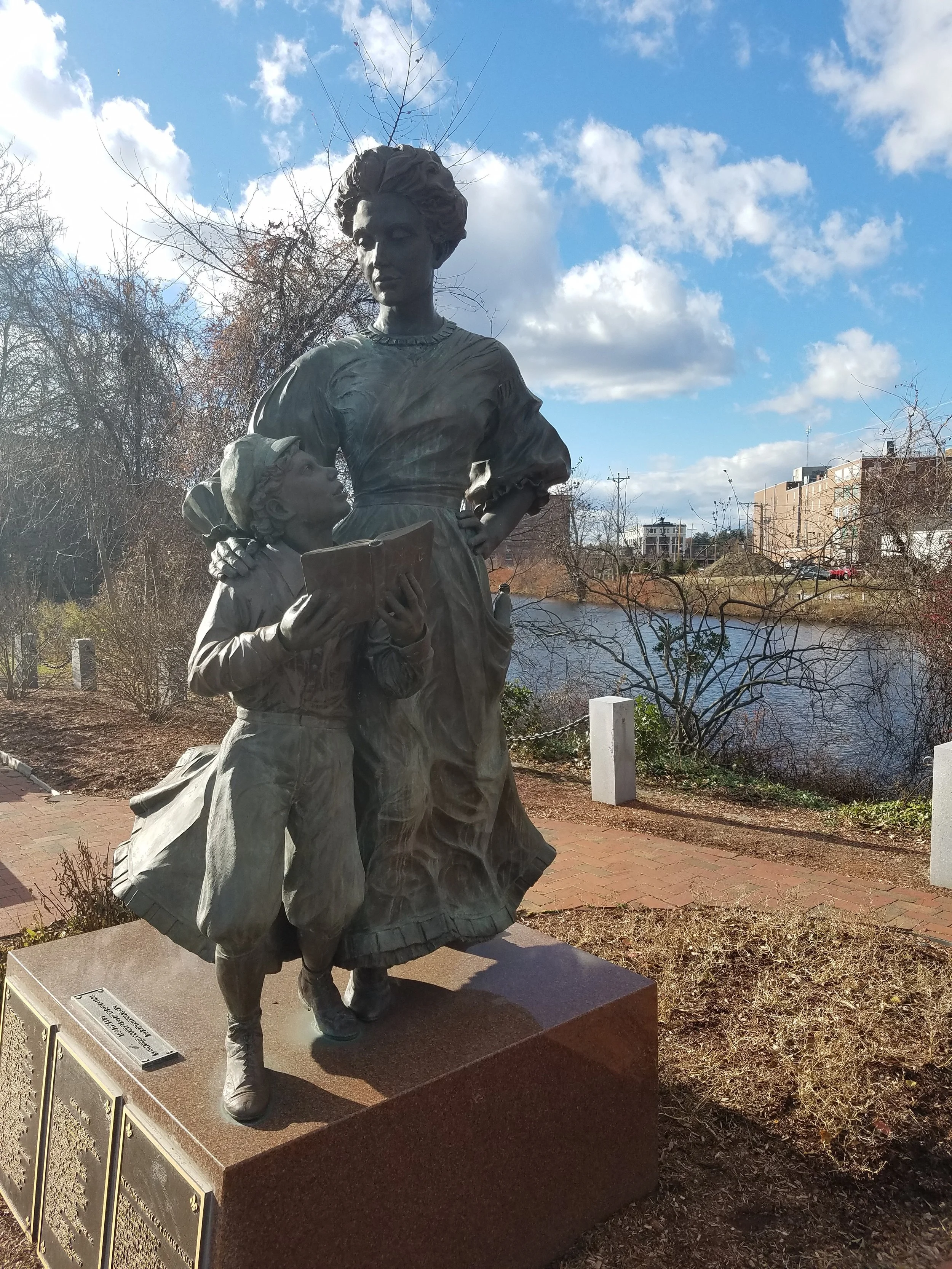
This 6-foot bronze statue, Notre Renaissance Francaise, off the Nashua River near the Main Street bridge and Water Street in Nashua, pay homage to the French Canadian community and female millworkers who toiled in the textile mills along the river.
12-07-17
The gift and grace of true beauty
“To behold beauty dignifies your life; it heals you and calls you out beyond the smallness of your own self-limitation to experience new horizons. To experience beauty is to have your life enlarged.”
– John O’Donohue, “Beauty: The Invisible Embrace”
True beauty catches us off-guard. True beauty offers a powerful argument for art – not just the things we create – but also the art of living itself. Its lessons are subtle, but real and immutable. We all know the lessons beauty teaches us – but they are often invisible, imbedded beneath the surface – and we sometimes forget what we know.
As an arts and cultural news journalist, I have always carried within me an inner argument for art, for creativity in a world that seems at times increasingly hostile to anything except the next day’s crisis. While sitting in weekly meetings of the Boston Globe New Hampshire Weekly at its offices at 1650 Elm St. in Manchester for 14 years, I dwelt on the periphery because my beat was back page “fluff” news in a “real” news front page culture.
In my weekly ruminations, I realized that the very intangibles of art and culture – the books we read, the poems we write, paintings we love, the hand-crafted object that is so dear to us, the play that transforms our understanding, the pure movement of dance – represent the trail of creativity that speaks to a different part of our psyche. While the timely story of yesterday’s fire might line the litter box, my article might end up on the refrigerator. One was timely, the other, timeless.
No one has ever put the argument better to me than poet, author and Celtic priest John O’Donohue, who is Da Vinci-like in his scholarship on the topic of beauty – eloquent in his exploration about why beauty matters terribly, and how it shapes nearly every aspect of culture, character and society.
I am not talking about skin-deep beauty, glamour, fashion or image – the kind of beauty that can be manipulated, changed, and possessed. True beauty cannot be owned, changed, or even fully comprehended. We catch it only in glimpses.
O’Donohue explains that we have assumed a superficial view of beauty that has cheapened it.
“Because beauty is conceived so naively, it appears merely naive and can be tolerated only if complicated by discord, shock or violence and harsh terrestrial realities. I therefore feel justified in speaking of the repression of beauty.”
As O’Donohue writes, beauty – our perception of beauty – is bestowed on us; it comes from “elsewhere,” from a place that is beyond ego, beyond the self and the selfie, beyond small-mindedness and emotional need. Beauty brings us to a place that is outside ourselves, a still sanctuary even if only for a moment, when we are touched by something profound because it so often comes as a surprise – the distinct sense of dwelling in an unexplained place of awe.
“Beauty cannot be forced. It alone decides when it will come and sometimes it is last thing we expect and the very last thing to arrive.” Artists know this lesson well, and spend hours, years, readying their skills so that they might set the context for beauty to happen.
Beauty is its own gift – no strings attached. The zen of beauty feels like a beginning, a clearance, a shift in awareness that is like pressing the inner reset button. Though we never ask why beauty happens, it remains a wonder that changes us. “With swift, sheer, grace, it is like a divine breath that blows the heart open. ...”
O’Donohue likens beauty to light itself, how even as it hovers on the familiar, it is always different, always changing. “Light never shows the same mountain twice. Only the blindness of habit convinces us ... that we see the same landscape. In truth, no place ever remains the same because light has no mind for repetition; it adores difference.”
Madeleine L’Engle, in her book “Walking on Water,” talks about the liberating quality of beauty in that it brings cosmos out of chaos, or as O’Donohue writes, “beauty offers us an invitation to order, coherence and unity.”
The priest connects the sense of awe we feel in the presence of beauty to hope, goodness, reverence and respect because beauty touches a part of us that is still innocent. Beauty, like Nature, “gently relieves and releases the caged mind.”
O’Donohue: “No one is immune to beauty ... Beauty is never a neutral experience.” When we are in the presence of beauty, we behave better, we are more apt to feel beauty inside.
Beauty shapes how we see: “The way we look at things has a huge influence on what becomes visible for us. Each of us is responsible for how we see, and how we see determines what we see. Seeing is not merely a physical act: the heart of vision is shaped by the state of the soul. When the soul is alive to beauty, we begin to see life in a fresh and vital way. The old habits of seeing are broken.”
If our response to beauty shapes what we see, it also shapes our approach to the world.
“When we approach with reverence, great things decide to approach us.... for beauty does not reserve itself for special, elite moments or instances; it does not wait for perfection but is present already secretly in everything....To live with reverence is to live without judgment, prejudice, and the saturation of consumerism. The consumerist heart becomes empty and lonesome because it has squandered reverence ... when our approach is respectful, sensitive and worthy, gifts of healing, challenge, and creativity open to us.”
O’Donohue argues that our disregard for privacy and the sacred space around each person, coupled with the lightning speed pace of the digital age has changed the way we experience time and space – and our concept of beauty itself. “We live under the imperative of the stand-alone digital instant; and ... that instant has become the measure not alone of time but also of space.”
Our obsession with the single instant and the immediate image robs us of a sense of sequence and the process of discovery. Insight and epiphany arrive in their own time.
A shock of beauty can take us out of chronological time; it is as if we have been suddenly touched by a flash of light. It may a mountaintop view; the orange sunset; the joy of walking in the woods; the sparkle of wonder in a child’s eye as he opens a new book; the painting that caught us off-guard; a moment of kindness; a thousand things, a thousand moments we stumble upon – if only we were looking.
O’Donohue counsels: “In difficult times you should always carry something beautiful in your mind. Rilke said that during such times we should endeavor to stay close to one simple thing in Nature.”
What do you see by the river? A woman and her child? A child excitedly clutching the wonder of a book? A mill girl empowered to make her own way, to care for her son? A beautiful sculpture in French Reniassance Park? The sunlight on the river in late fall?
O’Donohue advises: “Take your time and be everywhere you are.”
D. Quincy Whitney is a career journalist, author, historian and Nashua resident of more than 40 years. You can reach her through the Contact page on this site.